Nov 26, 2009


Nov 25, 2009

1848ish
An impassioned (EMERGENCY) manifesto from some fed up Hamburgers. It's always a relief to hear about problems in Europe, you know?—
Not in our name!
Jamming the gentrification machine: a manifesto
A spectre has been haunting Europe since US economist Richard Florida predicted that the future belongs to cities in which the "creative class" feels at home. "Cities without gays and rock bands are losing the economic development race," Florida writes. Many European capitals are competing with one another to be the settlement zone for this "creative class". In Hamburg's case, the competition now means that city politics are increasingly subordinated to an "Image City". The idea is to send out a very specific image of the city into the world: the image of the "pulsating capital", which offers a "stimulating atmosphere and the best opportunities for creatives of all stripes". A local marketing company feeds this image to the media as "the brand Hamburg". It is flooding the republic with brochures that turn Hamburg into a consistent, socially passified fantasialand with Elbe Philharmonic and table dancing, Blankenese and Schanzenviertel, agency life and art scenes, local Harley Days, gay parades in St. Georg, alternative art spectacles in the "HafenCity", Reeperbahn festivals, fan miles and Cruise Days. Hardly a week goes by without some tourist mega-event carrying out its "brand-strengthening function."
We say: Ouch, this is painful. Stop this shit. We won't be taken for fools. Dear location politicians: we refuse to talk about this city in marketing categories. We don't want to "position" local neighbourhoods as "colourful, brash, eclectic" parts of town, nor will we think of Hamburg in terms of "water, cosmopolitanism, internationality," or any other "success modules of the brand Hamburg" that you chose to concoct. We are thinking about other things. About the million-plus square metres of empty office space, for example, or the fact that you continue to line the Elbe with premium glass teeth. We hereby state, that in the western city centre it is almost impossible to rent a room in a shared flat for less than 450 Euro per month, or a flat for under 10 Euro per square meter. That the amount of social housing will be slashed by half within ten years. That the poor, elderly and immigrant inhabitants are being driven to the edge of town by Hartz IV (welfare money) and city housing-distribution policies. We think that your "growing city" is actually a segregated city of the 19th century: promenades for the wealthy, tenements for the rabble.
Which is why we want nothing to do with the ad campaign for "brand Hamburg". Not that you asked us nicely. On the contrary: it has not escaped our attention that cultural funding for artists has been on the decline for years, and is increasingly linked to local political criteria. Look at Wilhelmsburg, Neue Große Bergstraße and Hafencity: artists are expected to follow the funding money and interim-use opportunities like donkeys after carrots – into development areas that need life injecting into them, or investors or new, more solvent residents. You obviously consider it a matter of course that cultural resources should be siphoned "directly into urban development", "to boost the city's image". Culture should be an ornament for turbo-gentrification. St. Pauli and Schanzenviertel are shining examples of what this means: former working class districts become "trendy areas" and, in no time at all, exclusive residential areas with adjoining party and shopping neighbourhoods, where food and clothing chains like H&M milk the amusement-hungry hordes.
Hamburg's cultural politics has long formed an integral component of youreventification strategy. Thirty million Euro was poured into the militaria museum of some reactionary prince collector. Over forty percent of cultural spending is earmarked for the "Elb philhamonic Hall". The cultural authorities have been taken hostage by this 500-million Euro grave which, on completion, will at best be a luxury venue for megastars from the international classical and jazz circus. Quite apart from the fact that the symbolic effect of the Elb Philharmonic Hall is socially cynical to the core: the city is building a "lighthouse project", which offers the moneyed aristocracy a five-star hotel and 47 exclusive freehold apartments, and a draughty viewing platform for the general public. How telling!
And the "growing city" is making it increasingly hard to find halfway affordable studios and rehearsal rooms, or to run clubs and venues, which are not tied to the dictates of turnover. Which is why we say: the last people who should be talking about "pulsating art and music scenes" are city councillors who essentially leave it up to the tax office to decide what should happen on state property. Whenever money is to be made in the inner city, whenever a park can be squeezed, a building slapped onto a patch of green, or a hole filled, the tax office will toss these "prime locations" onto the property market, to the highest bidder with a minimum of conditions. And the result is a history and culture-free investor city of steel and concrete.
We get the picture: We, the music, DJs, art, film and theatre people, the groovy-little-shop owners and anyone who represents a different quality of life, are supposed to function as a counterpoint to the "city of subterranean parking" (Süddeutsche Zeitung). We are meant to take care of the atmosphere, the aura and leisure quality, without which an urban location has little chance in the global competition. We are welcome. In a way. On the one hand. On the other, the blanket development of urban space means that we - the decoys – are moving out in droves, because it is getting increasingly impossible to afford space here.
In the mean time, dear location politicians, you have noticed that this will have a negative impact on your plans. But then, tragically, your proposed solutions never venture one iota beyond the logic of the corporate city. A freshly printed document from the Senate announces its plan to "develop the future potential of the creative economy by strengthening its competitiveness." It will set up a "creative agency" to function, among other things as "the point of contact for real estate brokerage". If you can't afford to pay the rent, you can get yourself ranked as a "young artist" and consult the creative agency about "temporary usage of empty buildings". You can even get the rent subsidised if you provide proof of "urgent necessity and relevance for Hamburg as a creative location". There could not be a more unequivocal definition of the role that "creativity" is supposed to play: namely of profit centre for the "growing city".
And this is where we draw the line. We don't want any of the quartier developers' strategically placed "creative real estate" or "creative yards". We come from squatted housed, stuffy rehearsal rooms, we started clubs in damp cellars and in empty department stores. Our studios were in abandoned administrative buildings and we preferred un-renovated over renovatedbuildings because the rent was cheaper. In this city, we have always been on the look out for places that had temporarily fallen off the market – because we could be freer there, more autonomous, more independent. And we don't want to increase their value now. We don't want to discuss "how we want to live" in urban development workshops. As far as we are concerned, everything we do in this city has to to with open spaces, alternative ideas, utopias, with undermining the logic of exploitation and location.
We say: A city is not a brand. A city is not a corporation. A city is a community. We ask the social question which, in cities today, is also about a battle for territory. This is about taking over and defending places that make life worth living in this city, which don't belong to the target group of the "growing city". We claim our right to the city – together with all the residents of Hamburg who refuse to be a location factor.
*
The Not in our Name manifesto NION now has several thousand signatories including musicians, writers and painters like Ted Gaier Daniel Richter, Rocko Schamoni and Christoph Twickel.

Nov 23, 2009

news
Actors and musicians crowd the Sistine Chapel during their meeting with Pope Benedict XVI at the Vatican, Saturday, Nov. 21, 2009. The Pontiff spoke to more than 250 people—painters, sculptors, architects, writers, dancers, musicians, actors and directors—seated amid the frescoed beauty of the Sistine Chapel. "Through your art, you yourselves are to be heralds and witnesses of hope for humanity,'' he said. But he warned them to guard against "seductive but hypocritical'' beauty that creates "indecency, transgression or gratuitous provocation.''

It's all happening—I saw this business in People Magazine. I'm trying to lighten up, but the hysterical, utterly uncontrollable laughter these pictures occasion in me verges on madness, not okay-ness. Oh G-d.
Note to Pillow: The book is called GLAMOUR PUSS. GLAMOUR PUSS!
enders again
Three more of these "Defining the Noughties" entries from Intelligent Life. I excerpted them here because to link them from the site would have meant subjecting you fine folks to Tina Brown's crazyface submission (it involved Bernie Madoff [his smile, even]...I, in turn, submit memory loss [or shortness/shallowness of history] as among the definitive features of this near-passed decade)—
ANDY BECKETT, Journalist and author of “When the Lights Went Out: Britain in the Seventies”
Hoodies
Most teen styles in this decade looked back to earlier trends: skinny trousers were originally a 1960s working-class style that cropped up again in the 1970s new wave; emos were really just a re-working of the 1980s goth. But the hoodie belonged to the Noughties. I don’t believe it was just about the ASBO generation hiding their faces from CCTV, either. It’s more practical than that. If you spend all your time hanging around on the street in a coldish, wettish country, a hood will keep you warm, and stops the rain spoiling your hairstyle. Plus it creates a safe anonymity for a teenage boy to hide in: if you’re a skinny, pimply 14-year-old who has to deal with a lot of confrontation, putting your hood up means that, from behind at least, someone might take you for something more dangerous than you really are. Interestingly, it’s one of the few examples of working-class style that crossed all class boundaries: though I don’t think you’d catch him in huge, hip-hop sweatpants, even Prince Harry has been seen in a hoodie.
JULIA PEYTON-JONES, Director of the Serpentine Gallery, London
Apple. Instant landmarks. Price tags
On any future film set seeking to represent the decade, technology, and in particular Apple, would have to be central. Architecture too. It’s not that no one was aware of architecture or design technology before, but it was in this decade that these things became embedded in our lives. Zaha Hadid, Rem Koolhaas, Sir Norman Foster: landmarks for eternity appeared worldwide. Think of Dubai and what it represents: the idea that things can appear out of nowhere as if ready-made: it didn’t exist a moment ago and now here it is, fully formed. And what underpins this is the thing that underpins everything else: the pound or dollar sign. This was the decade when it became completely acceptable that there was a price tag for everything.
TOM HUNTER, Photographer
Mega pixels
Pixellated images are a very important part of the look of this decade. With the twin towers, Abu Graib and so on, most of the images we saw were very pixellated: a lot of them were shot at distance on video cameras or cellphones. These were not theHasselblad images we got back from the surface of the Moon in the 1960s. Plus everyone has a phone on them now and everyone is recording stuff all the time, so the low-res, heavily pixellated image is very much the means by which we see things. Imagery is no longer the preserve of professional image-makers.
Nov 22, 2009
I came across a Bible verse I liked (yes, a Bible verse...Pillow and I are both on that Church tip today) by way of John Hollander—
...and the grasshopper shall be a burden, and desire shall fail: because man goeth to his long home, and the mourners go about the streets. (Ecclesiastes, 12:5)
I'm not dying and neither (praise/bless) are any of my kin, blood or otherwise. My parents are selling, have sold, the house I grew up in. It will belong to some family transplanting themselves from Philadelphia as of early January. And I'll be in New York for Christmas and Key West for New Year, and this will be my last week in this house, a dark brick foursquare (larger than most) built in 1910 in the Central Gardens of Memphis, Tennessee. I don't know what to do. I've been kissing the walls and door frames, feeling my feet round the back stair toward the kitchen, feeling how they know just how to, photographing the patches of light that drift up and down the walls of my bedroom, photographing the warp of crape myrtle and dogwood and pin oak branches through poured glass, photographing the civil conversation between the pocket doors in the entry hall.
I thought I might die on my flight down here (coincidentally) above greater Philadelphia. We hit a patch of turbulence, the sort where the plane both rumbles from side to side and makes great, angular leaps up and down, where one is just waiting for the electricity to falter and everyone is looking around at each other like, "Oh No." But then we got steady and service began and I got a bloody mary and listened to Dusty in Memphis and opened and closed my eyes and landed. And there were my parents and my sister, and we went straight to supper and knew everybody in the place (Daddy said, "Nobody can pee without stopping to say hello how are you."). It was Memphis (my Memphis), all warmth and inside and known quantities, and it didn't matter that I was wearing slippers and no bra (I was home).
The next day, I took a drive. I got a grocery list from Mama. I drove all over. I drove out of the way; I got lost too, mixed up Walnut Grove and North Highland, forgot my shortcuts. None of it was as easy as I'd wished. I'd wished to have an old day back, to be driving to Kroger or down on Summer, as a citizen, as a person who lived here and was still in school, in the sun and unloaded, aware of how much I liked it here and liked a drive, but not that it was already gone. I brought the groceries home.
I went to get my nails painted (for some hosting duties to follow later, a big event). I pulled into the parking lot of the strip mall on Union Avenue where you find Rose's Nails and Wiles-Smith Drugs and Mr. Galtelli's Shoe Repair. And the women all remembered me. Of course—I get my nails did every week and did there for every week of several years. But I'm funny about this stuff; I assume people forget me, like I remember but they must forget. They even remembered that I lived in New York and they asked a lot of questions about the pace and the weather, and I just said it was good but very exhausting and not yet cold. And before my base coat was on, old Mr Galtelli's daughter breezed in to get a fill. She's a love, so effusive and bright, insanely forthcoming. Another customer complimented this beautiful old, garland-set diamond she was wearing and away she went, "Oh that was Mother's ring. I wear Mother's ring on one hand and Daddy's on the other, or at least when I need strength, on hard days. You know, Mother died almost a year to today, just a few months after Daddy. It's been hard but it makes you strong. I'm a stronger person. I've been running the shop for two years now. When Daddy was diagnosed with lung cancer I came back up here. I quit my job and divorced my husband and sold my house all at once. I mean it felt like a day. And I mean, he was a bad guy, just a loser and real jealous, real jealous of all the time I came up here to spend with my family. And I mean, that's my family. He was my husband but that's my family. Anyway, it was the right thing to do. People just loved Daddy. I've got third and fourth generation customers. People who knew my Grandaddy too.....[directed at "Rose"] can you do my eyebrows girl? I need a mini-facelift. I've got a date tonight. My boyfriend is coming over with his son and we're gonna grill out. It sounds crazy, right? It might be too cold. But that's what we're gonna do, have some chicken and some macaroni probably and I'll make brownies, gotta make something bad....[maybe thirty seconds of silence] Girl, I see you walking past the store all the time. Where are you walking to? You've gotta be careful 'round here, especially behind the building." and "Rose" (I call her that but I'm pretty sure it's not her name) says, "Oh I walk. I walk when I get here early, before I open. I walk in the afternoon. I go around the block. I go to Peabody. I really love this area. I love this area. The houses are so nice, so nice." I dried my nails for six minutes and then three more. I told them I'd be back again, right before they closed for the holiday.
Nov 21, 2009


Verses
Charles Olson
THE KINGFISHERS
1
What does not change / is the will to change
He woke, fully clothed, in his bed. He
remembered only one thing, the birds, how
when he came in, he had gone around the rooms
and got them back in their cage, the green one first,
she with the bad leg, and then the blue,
the one they had hoped was a male
Otherwise? Yes, Fernand, who had talked lispingly of Albers & Angkor Vat.
He had left the party without a word. How he got up, got into his coat,
I do not know. When I saw him, he was at the door, but it did not matter,
he was already sliding along the wall of the night, losing himself
in some crack of the ruins. That it should have been he who said, "The kingfishers!
who cares
for their feathers
now?"
His last words had been, "The pool is slime." Suddenly everyone,
ceasing their talk, sat in a row around him, watched
they did not so much hear, or pay attention, they
wondered, looked at each other, smirked, but listened,
he repeated and repeated, could not go beyond his thought
"The pool the kingfishers' feathers were wealth why
did the export stop?"
It was then he left
2
I thought of the E on the stone, and of what Mao said
la lumiere"
but the kingfisher
de l’aurore"
but the kingfisher flew west
est devant nous!
he got the color of his breast
from the heat of the setting sun!
The features are, the feebleness of the feet (syndactylism of the 3rd & 4th digit)
the bill, serrated, sometimes a pronounced beak, the wings
where the color is, short and round, the tail
inconspicuous.
But not these things are the factors. Not the birds.
The legends are
legends. Dead, hung up indoors, the kingfisher
will not indicate a favoring wind,
or avert the thunderbolt. Nor, by its nesting,
still the waters, with the new year, for seven days.
It is true, it does nest with the opening year, but not on the waters.
It nests at the end of a tunnel bored by itself in a bank. There,
six or eight white and translucent eggs are laid, on fishbones '
not on bare clay, on bones thrown up in pellets by the birds.
On these rejectamenta
(as they accumulate they form a cup-shaped structure) the young are born
And, as they are fed and grow, this nest of excrement and decayed fish becomes
a dripping, fetid mass
Mao concluded:
nous devons
nous lever
et agir!
3
When the attentions change / the jungle
leaps in
even the stones are split
they rive
Or,
enter
that other conqueror we more naturally recognize
he so resembles ourselves
But the E
cut so rudely on that oldest stone
sounded otherwise,
was differently heard
as, in another time, were treasures used:
(and, later, much later, a fine ear thought
a scarlet coat)
"of green feathers feet, beaks and eyes
of gold
"animals likewise,
resembling snails
"a large wheel, gold, with figures of unknown four-foots,
and worked with tufts of leaves, weight
3800 ounces
"last, two birds, of thread and featherwork, the quills
gold, the feet
gold, the two birds perched on two reeds
gold, the reeds arising from two embroidered mounds,
one yellow, the other
white.
"And from each reed hung
seven feathered tassels.
In this instance, the priests
(in dark cotton robes, and dirty,
their dishevelled hair matted with blood, and flowing wildly
over their shoulders)
rush in among the people, calling on them
to protect their gods
And all now is war
where so lately there was peace,
and the sweet brotherhood, the use
of tilled fields.
4
Not one death but many,
not accumulation but change, the feed-back proves, the feed-back is
the law
Into the same river no man steps twice
When fire dies air dies
No one remains, nor is, one
Around an appearance, one common model, we grow up
many. Else how is it,
if we remain the same,
we take pleasure now
in what we did not take pleasure before? love
contrary objects? admire and/or find fault? use
other words, feel other passions, have
nor figure, appearance, disposition, tissue
the same?
To be in different states without a change
is not a possibility
We can be precise. The factors are
in the animal and/or the machine the factors are
communication and/or control, both involve
the message. And what is the message? The message is
a discrete or continuous sequence of measurable events distributed in time
is the birth of air, is
the birth of water, is
a state between
the origin and
the end, between
birth and the beginning of
another fetid nest
is change, presents
no more than itself
And the too strong grasping of it,
when it is pressed together and condensed,
loses it
This very thing you are
II
They buried their dead in a sitting posture
serpent cane razor ray of the sun
And she sprinkled water on the head of the child, crying
"Cioa-coatl! Cioa-coatl!"
with her face to the west
Where the bones are found, in each personal heap
with what each enjoyed, there is always
the Mongolian louse
The light is in the east. Yes. And we must rise, act. Yet
in the west, despite the apparent darkness (the whiteness
which covers all), if you look, if you can bear, if you can, long enough
as long as it was necessary for him, my guide
to look into the yellow of that longest-lasting rose
so you must, and, in that whiteness, into that face, with what candor, look
and, considering the dryness of the place
the long absence of an adequate race
(of the two who first came, each a conquistador, one healed, the other
tore the eastern idols down, toppled
the temple walls, which, says the excuser
were black from human gore)
hear
hear, where the dry blood talks
where the old appetite walks
la piu saporita et migliore
che si possa truovar al mondo
where it hides, look
in the eye how it runs
in the flesh / chalk
but under these petals
in the emptiness
regard the light, contemplate
the flower
whence it arose
with what violence benevolence is bought
what cost in gesture justice brings
what wrongs domestic rights involve
what stalks
this silence
what pudor pejorocracy affronts
how awe, night-rest and neighborhood can rot
what breeds where dirtiness is law
what crawls
below
III
I am no Greek, hath not th'advantage.
And of course, no Roman:
he can take no risk that matters,
the risk of beauty least of all.
But I have my kin, if for no other reason than
(as he said, next of kin) I commit myself, and,
given my freedom, I'd be a cad
if I didn't. Which is most true.
It works out this way, despite the disadvantage.
I offer, in explanation, a quote:
si j'ai du gout, ce n'est gueres
que pour la terre et les pierres
Despite the discrepancy (an ocean courage age)
this is also true: if I have any taste
it is only because I have interested myself
in what was slain in the sun
I pose you your question:
shall you uncover honey / where maggots are?
I hunt among stones
1949
THE KINGFISHERS
1
What does not change / is the will to change
He woke, fully clothed, in his bed. He
remembered only one thing, the birds, how
when he came in, he had gone around the rooms
and got them back in their cage, the green one first,
she with the bad leg, and then the blue,
the one they had hoped was a male
Otherwise? Yes, Fernand, who had talked lispingly of Albers & Angkor Vat.
He had left the party without a word. How he got up, got into his coat,
I do not know. When I saw him, he was at the door, but it did not matter,
he was already sliding along the wall of the night, losing himself
in some crack of the ruins. That it should have been he who said, "The kingfishers!
who cares
for their feathers
now?"
His last words had been, "The pool is slime." Suddenly everyone,
ceasing their talk, sat in a row around him, watched
they did not so much hear, or pay attention, they
wondered, looked at each other, smirked, but listened,
he repeated and repeated, could not go beyond his thought
"The pool the kingfishers' feathers were wealth why
did the export stop?"
It was then he left
2
I thought of the E on the stone, and of what Mao said
la lumiere"
but the kingfisher
de l’aurore"
but the kingfisher flew west
est devant nous!
he got the color of his breast
from the heat of the setting sun!
The features are, the feebleness of the feet (syndactylism of the 3rd & 4th digit)
the bill, serrated, sometimes a pronounced beak, the wings
where the color is, short and round, the tail
inconspicuous.
But not these things are the factors. Not the birds.
The legends are
legends. Dead, hung up indoors, the kingfisher
will not indicate a favoring wind,
or avert the thunderbolt. Nor, by its nesting,
still the waters, with the new year, for seven days.
It is true, it does nest with the opening year, but not on the waters.
It nests at the end of a tunnel bored by itself in a bank. There,
six or eight white and translucent eggs are laid, on fishbones '
not on bare clay, on bones thrown up in pellets by the birds.
On these rejectamenta
(as they accumulate they form a cup-shaped structure) the young are born
And, as they are fed and grow, this nest of excrement and decayed fish becomes
a dripping, fetid mass
Mao concluded:
nous devons
nous lever
et agir!
3
When the attentions change / the jungle
leaps in
even the stones are split
they rive
Or,
enter
that other conqueror we more naturally recognize
he so resembles ourselves
But the E
cut so rudely on that oldest stone
sounded otherwise,
was differently heard
as, in another time, were treasures used:
(and, later, much later, a fine ear thought
a scarlet coat)
"of green feathers feet, beaks and eyes
of gold
"animals likewise,
resembling snails
"a large wheel, gold, with figures of unknown four-foots,
and worked with tufts of leaves, weight
3800 ounces
"last, two birds, of thread and featherwork, the quills
gold, the feet
gold, the two birds perched on two reeds
gold, the reeds arising from two embroidered mounds,
one yellow, the other
white.
"And from each reed hung
seven feathered tassels.
In this instance, the priests
(in dark cotton robes, and dirty,
their dishevelled hair matted with blood, and flowing wildly
over their shoulders)
rush in among the people, calling on them
to protect their gods
And all now is war
where so lately there was peace,
and the sweet brotherhood, the use
of tilled fields.
4
Not one death but many,
not accumulation but change, the feed-back proves, the feed-back is
the law
Into the same river no man steps twice
When fire dies air dies
No one remains, nor is, one
Around an appearance, one common model, we grow up
many. Else how is it,
if we remain the same,
we take pleasure now
in what we did not take pleasure before? love
contrary objects? admire and/or find fault? use
other words, feel other passions, have
nor figure, appearance, disposition, tissue
the same?
To be in different states without a change
is not a possibility
We can be precise. The factors are
in the animal and/or the machine the factors are
communication and/or control, both involve
the message. And what is the message? The message is
a discrete or continuous sequence of measurable events distributed in time
is the birth of air, is
the birth of water, is
a state between
the origin and
the end, between
birth and the beginning of
another fetid nest
is change, presents
no more than itself
And the too strong grasping of it,
when it is pressed together and condensed,
loses it
This very thing you are
II
They buried their dead in a sitting posture
serpent cane razor ray of the sun
And she sprinkled water on the head of the child, crying
"Cioa-coatl! Cioa-coatl!"
with her face to the west
Where the bones are found, in each personal heap
with what each enjoyed, there is always
the Mongolian louse
The light is in the east. Yes. And we must rise, act. Yet
in the west, despite the apparent darkness (the whiteness
which covers all), if you look, if you can bear, if you can, long enough
as long as it was necessary for him, my guide
to look into the yellow of that longest-lasting rose
so you must, and, in that whiteness, into that face, with what candor, look
and, considering the dryness of the place
the long absence of an adequate race
(of the two who first came, each a conquistador, one healed, the other
tore the eastern idols down, toppled
the temple walls, which, says the excuser
were black from human gore)
hear
hear, where the dry blood talks
where the old appetite walks
la piu saporita et migliore
che si possa truovar al mondo
where it hides, look
in the eye how it runs
in the flesh / chalk
but under these petals
in the emptiness
regard the light, contemplate
the flower
whence it arose
with what violence benevolence is bought
what cost in gesture justice brings
what wrongs domestic rights involve
what stalks
this silence
what pudor pejorocracy affronts
how awe, night-rest and neighborhood can rot
what breeds where dirtiness is law
what crawls
below
III
I am no Greek, hath not th'advantage.
And of course, no Roman:
he can take no risk that matters,
the risk of beauty least of all.
But I have my kin, if for no other reason than
(as he said, next of kin) I commit myself, and,
given my freedom, I'd be a cad
if I didn't. Which is most true.
It works out this way, despite the disadvantage.
I offer, in explanation, a quote:
si j'ai du gout, ce n'est gueres
que pour la terre et les pierres
Despite the discrepancy (an ocean courage age)
this is also true: if I have any taste
it is only because I have interested myself
in what was slain in the sun
I pose you your question:
shall you uncover honey / where maggots are?
I hunt among stones
1949

Oh Cyrus
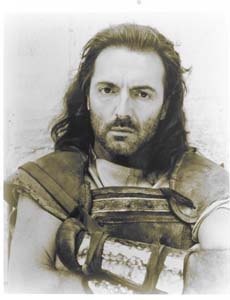
Well for one, we were 12 when this happened and the time was ripe for a dreamy, lusty, star-packed miniseries adaptation of Homer's Odyssey. There are times when we go off the rails here at A&P with the "ugly-hot" and all those "ethnics" and the young ones and the crazy estylish, but sometimes we just need to step back and appreciate the classically handsome. Armand Assante, I am glad you are in this world, walking around, being hot and stuff. Talk to me on a boat.

Nov 17, 2009
It's getting emotionally dangerous for me to think about someday being able to purchase big-old paintings at auction....this creep would just be such a joy to live with!--check the pretty shells and coral fastened (pinned?) to the air and that shadowy, sexually ambitious (and drunken?) guard dog in the bottom left. Woah now.

Nov 16, 2009
schmaltz and crackers
Dyspepsia.
Sunday evening, after some serious thrills at the new-ish American Wing (goodness), the sale of my childhood home and two hours spent watching Sex Rehab with Dr. Drew left me sour and achey—ill still—no joke. I'm pretty delicate.
So I've been tending my condition with flat cola and saltines and...soap:
—Billy Baldwin Decorates—a painting hung on a mirrored panel and then this sort of line:
"I think an unpleasant atmosphere results from the entry into the obviously 'rich' room—the kind that makes you feel like you're caught right in the middle between the devil of a museum and the deep sea of embarras de richesse. And a thing you can say for Southern women—they're far less guilty on this score than Northerners." (Yes and no...sure. I'm thinking about houses is Memphis and those ways of entertaining [possessing enough natural oldness and eccentricity to be easy about keeping some "regular," even low-low things, foods, habits], but also favorite, accidentally cluttered or accidentally barren New York apartments and what a good time I've had at/with The Met lately.)
—two songs: Rihanna's "Russian Roulette" (I've been critical of the album art [for no particular reason] and last week's Diane Sawyer interview left a bad taste in my mouth, but this track is great, I find...plotting, plodding, as heavy and Eastern as the title suggests, totally transSIBERIAN!) and then also Mary J. "I'm Going Down," yes (musical theater).
—David Hare's screenplay for Michael Cunningham's "The Hours."
—this ad (I mean, yipeee).
—this program too, watched on and off after meeting that confederate spur(er of a new-future collection) in Louisville (featured below)...the interviews are wonderful.

ender
generally not a great fan of year-end (or now, decade-end) lists. but the format of this guy from the economist's vanity mag intelligent life (wow) is quite good....a group of number-less, free-form entries from professional aesthetes about the way the aughts (or, as the brit's have it, 'the noughties') looked. there is some cultural dissonance (sienna miller [not half so important as m.k. olsen]....jade jagger?, combat fatigues?), but also some winning stuff: the bits about iPods, bags, celebrity, and vomit....
Nov 15, 2009

Nov 14, 2009
Bad Gurl 4 Lyfe: Cassie "Manuella Santos" Steele.
Um, apparently Cassie Steele is an even crazier bitch in real life. I don't know who Mr. Colson is (I like to think he's Degrassi's middle-aged on-set tutor), but I fear for him. The same way I fear for every man I've ever loved. Please to enjoy her Canadian Top 40 Hit....?
Nov 13, 2009
Nail Color for the Weekend

OPI Holiday Glow, but no holiday today, just grateful that I'm able to spend a large chunk of today's work hours getting my nails did and killing time in a Park Slope coffee shop. The good news is that they play a lot of Kelly Clarkson here but the downside is that she's not drowning out the conversational English lessons on either side of me. They could also be blind dates but how would you ever know the difference?

Nov 11, 2009


Subscribe to:
Posts (Atom)